 PolyOMIC Solutions
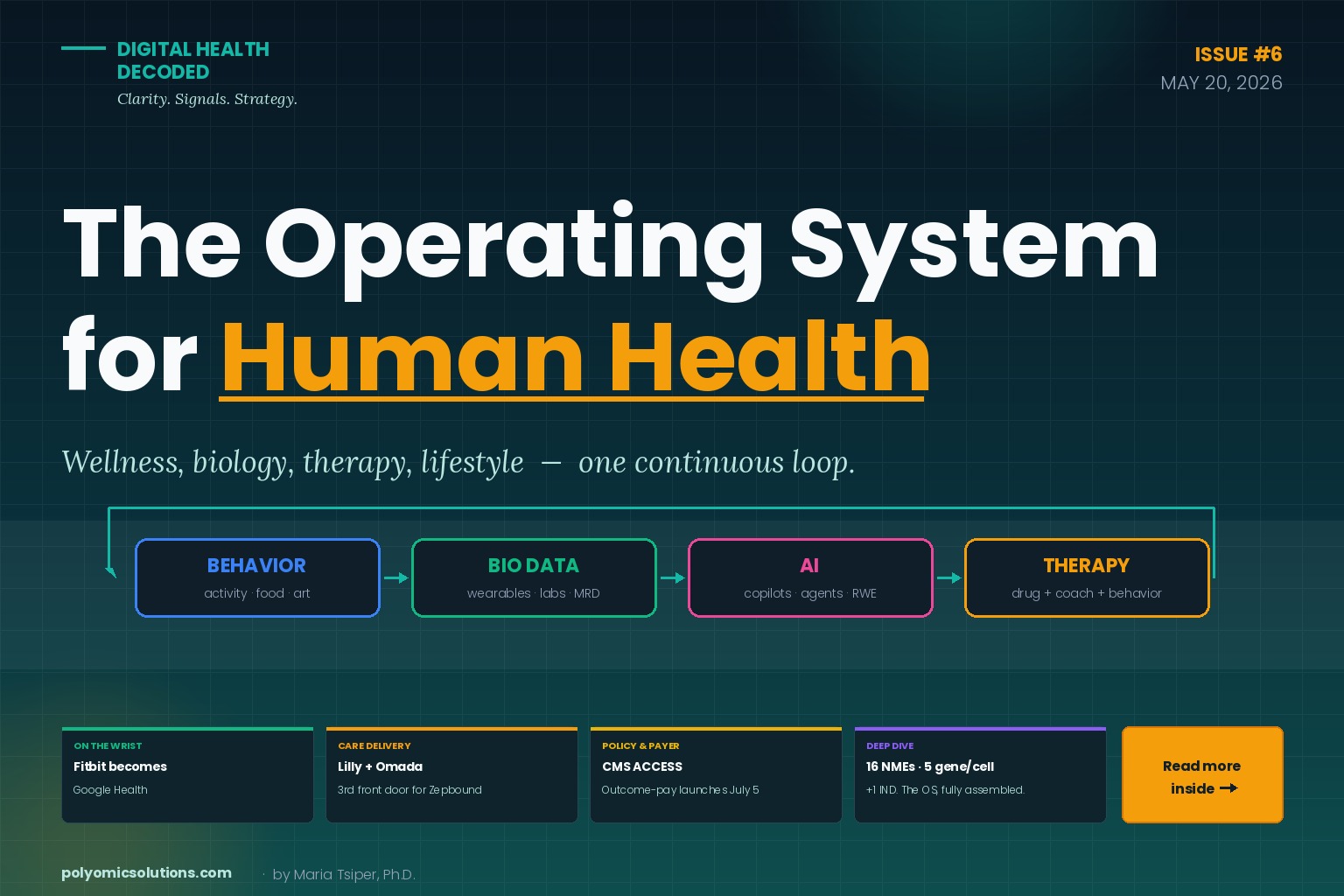
The Operating System for Human Health
Pharma adds coaching. Fitbit becomes Google Health. CMS pays for outcomes. Art moves the aging clock. The patient layer just became an operating system.
-
Fitbit becomes Google Health (May 19 rollout; in stores May 26). The Fitbit app auto-updates to the new Google Health app — with a Gemini-powered “Health Coach”, medical-record integration, and data feeds from Apple Health, Peloton, and MyFitnessPal. Fitbit Premium → Google Health Premium. Same launch window: screenless $99 Fitbit Air (Steph Curry edition $129.99).
↳ Continues Fitbit Air $99 launch (Issue #5). The category is shedding “fitness tracker” identity — the wearable is now the front end of a health platform, AI as the interface, medical records inside the same app.
👉 Why it matters: A step counter that now hosts your labs, your meds, and a 24/7 AI coach. Google is positioning to own the line between consumer wellness and clinical care. Google Health | Droid-Life →
-
AstraZeneca licenses Owkin’s K Pro “AI Scientist” for 3 years (May 13) — another top pharma commits to agentic AI that generates hypotheses, interrogates literature, surfaces drug targets, prioritizes indications, designs experiments, and maps the competitive landscape of clinical trials.
↳ Continues a pattern seen across Issues #4 and #5: pharma partners with AI vendors.
👉 Why it matters: Pharma licenses the AI engine rather than building it. Lilly gets molecules, Insilico keeps the platform. AZ gets agents, Owkin keeps K Pro. The defensibility sits on the AI side. Press release | MobiHealthNews →
-
Omada Health joins Lilly Employer Connect — Omada (Nasdaq: OMDA) becomes an independent program administrator in Lilly’s Employer Connect, offering its GLP-1 Care Track (clinical evaluation, prescribing, and ongoing medication management). The integration provides transparent net cost for Zepbound and lets employers set defined contribution levels. Same day, Omada reported Q1 2026 revenue of $78M (+42% YoY), 1.02M Total Members (+51% YoY), and a narrowed operating loss. Stock rose ~9% on the week. This is bigger than a distribution deal. It signals pharma’s transition into longitudinal digital care infrastructure — drug companies no longer just selling therapeutics, but building behavioral operating systems around them.
↳ Continues the “Two Front Doors” thesis (Issue #5) — now three channels, three unit economics, one drug. Omada’s coordinated lifestyle support is the adherence wrap that makes the employer channel work.
👉 Why it matters: Pharma is shifting into longitudinal digital care infrastructure. The GLP-1 wars are evolving from molecule competition to adherence, coaching, and outcomes. The moat is continuous patient engagement around the drug. Omada PR →
-
CMS ACCESS is ready for the July 5 launch (150+ first-cohort participants have enrolled by May 15 deadline).
How ACCESS works
Voluntary 10-year payment model (CMS Innovation Center) for Medicare Part B providers. Replaces fee-for-service with Outcome-Aligned Payments (OAPs): monthly prospective per-beneficiary payment + annual reconciliation tied to BP, HbA1c, depression scores, MSK pain.
4 clinical tracks · FHIR-based outcome reporting · quarterly cohorts through 2033, model runs through June 2036.
↳ Continues the ACCESS thread (Issue #3 → Issue #4). Insurers representing ~165M Americans across commercial, Medicare Advantage, and Medicaid have aligned their reimbursement with the ACCESS approach.
👉 Why it matters: July 5 stress-tests the “wearables → reimbursable medical signal” bridge. ACCESS pays for outcomes, not visits. Q4 2026 / Q1 2027 data will separate the digital-therapeutic companies that deliver from those that market. CMS ACCESS →
-
🔬 INDUSTRY-FIRST APPROVAL — FDA approves atezolizumab (Tecentriq) + Signatera CDx for ctDNA-positive MIBC (May 15). Two precedents: (1) Tecentriq as adjuvant for MIBC with molecular residual disease (MRD) post-cystectomy; (2) Natera’s Signatera — the first FDA-approved blood-based MRD companion diagnostic. Based on IMvigor011 Phase 3 (250 patients, 2:1 randomized; Genentech / Roche).
↳ Resolves the SERENA-6 question from Issue #5. SERENA-6 had immature OS; IMvigor011 brought mature OS (32.8 vs 21.1 mo, HR 0.59) with the CDx co-developed from trial design. FDA signal: ctDNA-guided treatment works when OS is mature and the CDx is built in.
👉 Why it matters: Third drug–CDx co-approval in three weeks (after Labcorp+KEYTRUDA in Issue #4 and Veppanu+Guardant360 in Issue #5). Adjuvant immunotherapy runs ~$196K/patient-year; Signatera-negative patients (~half) showed 97% 2-year OS without treatment. MRD-guided care is the economic gatekeeper. Natera stock +5%. FDA | Natera →
-
FDA approves Enhertu (T-DXd) for two new HER2+ early breast cancer indications (May 15, Daiichi Sankyo / AstraZeneca). First ADC into curative-intent HER2+ early breast cancer: (1) neoadjuvant T-DXd → THP for Stage II/III (DESTINY-Breast11); (2) adjuvant for residual invasive disease after neoadjuvant trastuzumab+taxane (DESTINY-Breast05). DB05 cut invasive recurrence or death 53% (HR 0.47); 3-year iDFS 92.4%.
Therapy timing — where this week’s approvals slot in
Early stage (curative-intent) ————————→ Metastatic (palliative)
✨ = May 15, 2026 approval. Note the different residual-disease modalities: HER2+ breast cancer uses pathologic assessment of the surgical specimen (histology of resected tissue and lymph nodes — the pCR vs RD framework). MIBC uses molecular assessment via Signatera ctDNA — the first FDA-approved blood-based MRD CDx. Signatera is approved only in combination with atezolizumab for MIBC; it is not used in breast cancer.
👉 Why it matters: Enhertu moves up the cancer-care timeline — from late-line metastatic into curative-intent neoadjuvant/adjuvant. Longer treatment durations, larger eligible population. Safety limits adoption: ILD/pneumonitis 4.4% (DB11) and 10% (DB05); boxed warning unchanged. FDA | AstraZeneca →
Personalized Medicine Hits Operational Reality
The Personalized Medicine Coalition (PMC) just released its Personalized Medicine at FDA: The Scope & Significance of Progress in 2025 report. The numbers, paired with this week’s Signatera and Enhertu approvals, make the same point: personalized medicine is no longer the headline. It’s the operating model.
📊 The 2025 backbone (PMC report)
| Metric | 2025 Result | Trend |
|---|---|---|
| Personalized NMEs approved (PMC definition) | 16 of 45 (36%) | 6th consecutive year >⅓ |
| New gene/cell therapies | 5 (MacTel, RDEB, SMA, hematopoietic, WAS) | 34 cumulative |
| CDx new/expanded indications | 16 testing systems | Liquid-biopsy CDx now routine |
| Blood-based Alzheimer’s tests | 2 cleared (Roche Elecsys pTau181; Fujirebio pTau217/Aβ) | Primary-care rule-out tools |
| AI drug-development tools qualified | 1 (AIM-MASH, first ever) | New regulatory pathway |
👉 The shape of progress: 62% of these approvals are in oncology, 29% in rare disease, 9% “other.” The story isn’t cancer alone — it’s that the tooling built for oncology (biomarker-guided drug + CDx + AI) is now being ported into rare disease and chronic conditions.
🧪 Inside the 16 Personalized NMEs — Four patterns to notice:
1. The first tumor-agnostic Keytruda label. Keytruda Qlex (subcutaneous formulation) is indicated for solid tumors with treatment decisions informed by any of nine markers: PD-L1, EGFR, ALK, MSI-H, dMMR, pMMR, TMB-H, HR, HER2. “Where is the cancer” is being replaced by “what is the cancer doing molecularly.”
2. KRAS goes from undruggable to ovarian. Avmapki Fakzynja Co-Pack is the first KRAS-targeted approval in low-grade serous ovarian cancer — continues the RAS-druggable thread from Revolution Medicines (Issue #4). A decade of “undruggable” textbooks just got an ovarian indication; KRAS-altered solid tumors are queued behind it.
3. NSCLC fragments into a molecular menu. Four of the 2025 NMEs target distinct NSCLC subpopulations: Emrelis (c-Met), Zegfrovy (EGFR exon 20), Hernexeos and Hyrnuo (both HER2 / ERBB2, different mechanisms). Lung cancer treatment is no longer “NSCLC vs SCLC” — it’s a molecular menu with matching diagnostics shipped alongside.
4. Personalized medicine breaks out of oncology. Redemplo (siRNA, FCS), Vanrafia (oral ETA antagonist gated by UPCR for IgAN), and Imaavy (anti-AChR / anti-MuSK in myasthenia gravis). The biomarker platform built for oncology is being ported into rare metabolic, kidney, and neuromuscular disease — where the prescription volume lives.
Modality breakdown of the 16
Datroway and Emrelis are the two ADCs; Redemplo (apoC-III-directed) is the only siRNA — the most novel modality of the cohort. Zero bispecifics, zero cell therapies (those sit in the 5 gene/cell therapy tally below).
🧬 Inside the 5: gene/cell therapies approved — plus 1 effective under IND
The 2025 cohort: five fundamentally different delivery modalities, FDA-cleared in twelve months. Personalized medicine is no longer defined by biomarkers alone — it’s defined by how deeply the therapy integrates into biology.
1. Encelto (revakinagene taroretcel, Neurotech) — MacTel Type 2. Allogeneic encapsulated cells secrete CNTF continuously inside the eye. A living bioreactor in place of chronic dosing.
2. Zevaskyn (prademagene zamikeracel, Abeona) — Recessive Dystrophic EB. Autologous keratinocytes corrected ex vivo to express functional type VII collagen, applied as a wound graft. Gene therapy as a repeatable dermatologic procedure.
3. Itvisma (onasemnogene abeparvovec-brve, Novartis Gene Therapies) — SMA, age 2+. AAV-delivered SMN1 replacement, now extended beyond the original Zolgensma under-2 population. Larger addressable population for the one-time curative model.
4. Omisirge (omidubicel-onlv, Gamida Cell) — Hematopoietic transplant support. Ex-vivo expanded allogeneic cord-blood progenitors that accelerate engraftment and neutrophil recovery. An off-the-shelf regenerative cell platform.
5. Waskyra (etuvetidigene autotemcel, Orchard Therapeutics) — Wiskott-Aldrich Syndrome. Autologous CD34+ stem cells with lentiviral WAS-gene insertion, reinfused to restore immune function. The immune system, rebuilt from the patient’s own corrected cells.
+1. Baby KJ’s bespoke CRISPR (custom-designed lipid-nanoparticle base-editing therapy, U Penn / CHOP team, IND-stage, not FDA-approved) — Severe CPS1 deficiency, n-of-1. A CRISPR therapy designed for one specific infant. FDA approved the expanded-access IND within one week of submission (Feb 14, 2025). By end of 2025, the infant was walking and talking. The first FDA-blessed playbook for n-of-1 gene editing — not a commercial product, but a regulatory precedent for ultra-rare individualized therapies.
Five different ways to put a working biological instruction inside the body — implanted cell factories, ex-vivo gene-corrected tissue grafts, in vivo AAV gene replacement, allogeneic regenerative cells, and autologous gene-edited stem cells — cleared by FDA in twelve months. Plus a sixth: a CRISPR therapy designed for one patient and IND-approved in one week. The boundary between “a drug” and “a treatment for this person” just got porous.
🔮 AIM-MASH — the first FDA-qualified AI drug-development tool
Quietly, FDA also qualified AIM-MASH in 2025 — the first AI-based drug-development tool ever cleared under the Drug Development Tool Qualification Program. AIM-MASH evaluates liver biopsies in metabolic dysfunction-associated steatohepatitis. The qualification creates a new regulatory pathway for AI-driven assessment methods inside clinical trials. The pattern — FDA running AI internally (HALO + Elsa 4.0, Issue #5) while qualifying external AI tools — is now an active two-way street.
👉 What it adds up to: 16 personalized NMEs + 5 gene/cell therapies + 16 CDx + 1 AI development tool + 1 bespoke CRISPR for a single patient — in one year. The signal isn’t any one approval. It’s that the regulatory plumbing for personalized medicine is now fully operational, end to end.
The Operating System for Human Health
The boundary between wellness and medicine is dissolving — and the winners of the next decade may be the organizations that learn to operate on both sides of it at once.
Four stories filed this week under four different beats: a pharma–digital-health partnership, a wearable app rebrand, a CMS payment-model deadline, and an academic aging study. Each one looks self-contained. They aren’t. They’re describing the same underlying shift — the seams between behavior, biology, diagnostics, drugs, and AI are being engineered out of the system.
1. The drug now ships with a digital health coach.
Lilly’s deal with Omada Health makes Omada — a publicly-listed digital health company — an extension of the Zepbound prescribing pathway. It bundles the GLP-1 with clinical evaluation, prescribing, ongoing medication management, and lifestyle support in a single coordinated program with transparent net cost (Omada PR). The product isn’t the molecule anymore — it’s the outcome, which requires a behavior layer, adherence wrap, and continuous touchpoints between visits. Pharma is no longer shipping pharmaceuticals; it’s shipping digital health programs.
2. Fitbit becomes Google Health.
On May 19 — the day before this issue ships — the Fitbit app updated automatically into the Google Health app, complete with a Gemini-powered AI health coach, medical-record integration, and a Premium tier rebranded as Google Health Premium (official Google rollout). The category is shedding “fitness tracker” identity entirely. A device that started as a step counter is now positioned as the front end of a health platform — with AI as the interface, the patient’s own medical records inside the app, and Apple Health, Peloton, and MyFitnessPal feeding into the same dashboard. The same week, Google launched the screenless $99 Fitbit Air with Steph Curry. The signal couldn’t be clearer: the wrist is no longer a niche, it’s a beachhead.
3. CMS pays for wearable data.
The ACCESS Model’s application window closed May 15 with 150+ approved organizations. On July 5, Original Medicare begins paying for technology-supported chronic-care management through outcome-aligned payments tied to blood pressure, HbA1c, MSK pain, and depression scores (CMS ACCESS). For the first time, the wearable data stream isn’t a wellness signal — it’s the basis of a federal reimbursement claim. The line between “what your watch records” and “what your doctor bills for” is now a regulatory artifact, not a clinical one. Private payers covering ~165M lives have already committed to align with the same payment approach.
🎨 4. Art as longevity technology.
A UCL study (senior author Daisy Fancourt) in Innovation in Aging analyzed seven epigenetic aging clocks across 3,556 UK adults and found that weekly engagement with arts & culture — both as a “doer” (singing, painting, dancing) and a “consumer” (galleries, theater, concerts) — was associated with ~4% slower biological aging, comparable to regular exercise (UCL study; CNN coverage). “Honestly, it really surprises me,” said Steven Horvath, developer of the original epigenetic clock.
The epigenetic aging clocks — what they measure, what they need
| Clock | Gen | Sample / input | Trained on | Arts effect (UCL) |
|---|---|---|---|---|
| Hannum (2013) | 1st | Whole-blood DNAm array | Chronological age | — |
| Horvath2013 | 1st | DNAm array, multi-tissue | Chronological age | — |
| Horvath2018 (Skin & Blood) | 1st | Skin & blood DNAm array | Chronological age | — |
| Lin | 1st | Whole-blood DNAm array | Chronological age | — |
| PhenoAge (Levine 2018) | 2nd | Whole-blood DNAm + 9 clinical labs (training); DNAm only (app) | Phenotypic age | ✓ slower |
| GrimAge (Lu 2019) | 2nd | Whole-blood DNAm + 7 plasma proteins & smoking pack-years (training); DNAm only (app) | Time-to-death / mortality risk | not measured* |
| DunedinPoAm | 3rd | Whole-blood DNAm array | Pace of aging (Dunedin cohort) | ✓ slower |
| DunedinPACE (2022) | 3rd | Whole-blood DNAm array (~173 CpGs) | Pace of aging (refined) | ✓ slower |
Input in practice: all eight clocks require a single blood draw analyzed on a DNA methylation microarray (typically Illumina EPIC, ~850K CpG sites). Horvath2013 works across multiple tissues; the rest are blood-specific. The 2nd-generation clocks (PhenoAge, GrimAge) used additional clinical labs and plasma proteins in training, but at application require only the methylation profile.
*GrimAge was not included in the seven clocks measured by the UCL study. PhenoAge (the other 2nd-gen clock) and the two pace-of-aging clocks all showed slower aging; the four chronological-age clocks showed no effect. The biology of aging is moving from a single number to a panel.
If loneliness, purpose, creativity, and meaning-making move measurable biological markers, they aren’t “soft wellness” — they’re clinical variables, the same as systolic blood pressure or HbA1c. The future care team may include a creative-arts AI curator alongside the cardiologist, the GLP-1 prescriber, and the MRD monitor.
The synthesis
GLP-1 coaching. Wearables. MRD monitoring. AI copilots. Federal reimbursement tied to outcomes data. Epigenetic evidence that what you read, watch, and sing moves the same biology as what you swallow. Not five products — the components of one continuous system.
Healthcare in the 20th century was organized around places — hospitals, clinics, infusion centers, doctor’s offices. Healthcare in the next decade may be organized around a continuous loop:
The continuous loop — the new OS for human health
↳ and back to human behavior. 24/7. On the wrist and in the pocket.
The loop runs on the wrist, inside the pharmacy benefit, in the concert calendar, and through the employer’s benefits portal. It doesn’t require a building. It requires continuity.
The winners of the next decade may not be the best drug, diagnostics, or AI companies individually — but the organizations that own the feedback loop between those four layers. Lilly is building toward it with Omada and Insilico; AstraZeneca with Owkin; Google with Fitbit→Health and Gemini; Roche with PathAI and Signatera. The boundary lines on each org chart differ. The destination is the same.
👉Healthcare is being reorganized from a network of places into a single continuous loop of biological intelligence.
The question for every founder, investor, and operator reading this isn’t whether the integration happens. It’s which seam your company sits on when it does — and whether you own the surfaces on both sides of it, or just one. That is a fundamentally different healthcare system than the one we built in the 20th century.
Personalized Medicine at FDA: The Scope & Significance of Progress in 2025 — Personalized Medicine Coalition. Read the PDF →
Stay decoded.
Join readers getting the clearest signal in digital health — every Wednesday, free.
No spam. Unsubscribe anytime. Powered by Beehiiv.