 PolyOMIC Solutions
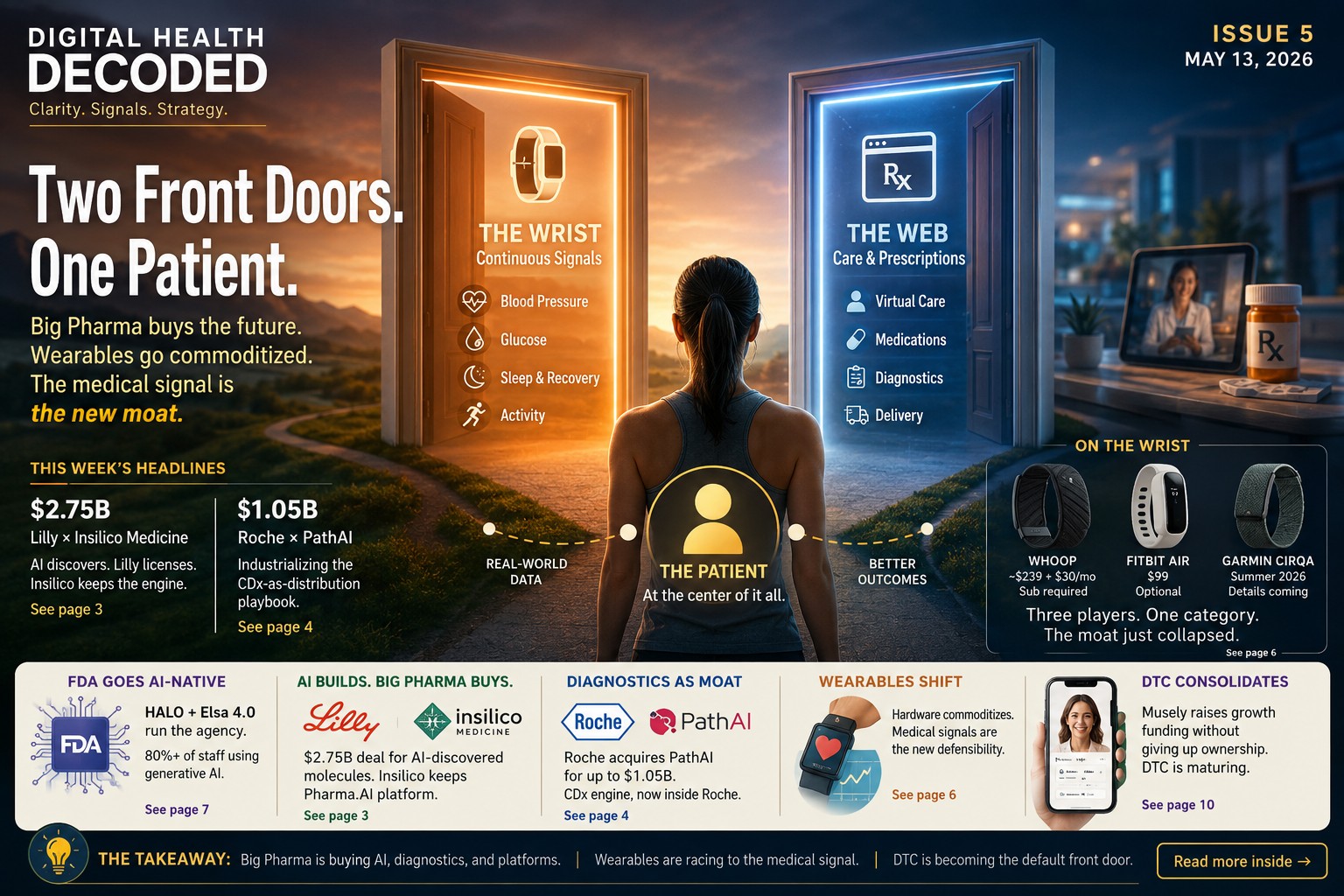
The New Front Doors
The wrist becomes a clinic. The website becomes a pharmacy. Both bypass the system in the middle.
-
Eli Lilly — Insilico Medicine ($2.75B licensing deal). Lilly buys worldwide rights to preclinical candidates from Insilico’s generative AI platform Pharma.AI. $115M upfront + up to $2.75B in development, regulatory, and commercial milestones, plus tiered royalties.
↳ Continues “Lilly Is Buying the Future” (Issue #4). The deal targets specific preclinical drug candidates discovered by Insilico’s Pharma.AI platform — Lilly licenses the molecules; Insilico keeps the platform.
👉 Why it matters: Big Pharma can now license drugs born in AI platforms it doesn’t own. Lilly gets the molecules; Insilico keeps the engine. The model: AI-native biotechs become specialized drug-discovery vendors to pharma at scale. Insilico PR →
-
Roche to acquire PathAI for up to $1.05B ($750M upfront + $300M milestones, May 7). PathAI’s AISight digital-pathology platform — including AI-enabled companion diagnostic algorithms — folds into Roche Diagnostics. Builds on a Roche-PathAI partnership active since 2021, expanded in 2024 to include CDx development.
↳ Pairs with Lilly — Insilico (above) and Labcorp + KEYTRUDA CDx / Veppanu + Guardant360 (Issue #4). Pharma is now buying the AI and the diagnostic that surrounds the drug.
👉 Why it matters: Roche is industrializing the CDx-as-distribution playbook. If the diagnostic is the launch (as we argued in Issue #4), owning the AI engine that generates the diagnostic is the new vertical-integration play. Roche press release →
-
Musely raises growth funding from General Catalyst — without giving up ownership (May 4). Most startup deals trade shares for cash; this one is structured more like a loan repaid from future revenue.
👉 Why it matters: Loan-style funding only works for businesses with steady, predictable profits — the kind that banks and credit funds want to lend against. Profitable direct-to-consumer health (telehealth + compounded dermatology + GLP-1) has matured into a category investors now treat like an established business, not a startup bet. TechCrunch →
-
Google launches Fitbit Air — $99 screenless WHOOP competitor (May 7, ships May 26). 5.2g pill-shaped tracker, no display, week-long battery, Gemini-powered Health Coach on optional Premium tier. Hardware does not require subscription.
↳ Continues “WHOOP hits $10B” (Issue #1). Five weeks after WHOOP’s valuation peak, Google launches a $99 attacker.
👉 Why it matters: The screenless wellness band category is being commoditized in real time. WHOOP’s subscription is now the only moat. Source →
-
Garmin CIRQA approaching launch (summer 2026). Trademark filings + “future of wearables” teaser confirm a screenless band is imminent.
👉 Why it matters: Three players in 8 weeks. The category formerly known as “WHOOP” now has three competitors. TechRadar →
-
FDA launches HALO + Elsa 4.0 — the agency becomes AI-native (May 6). HALO (“Harmonized AI & Lifecycle Operations for Data”) consolidates 40+ FDA application, submission, and portal systems into a single platform. Elsa 4.0 — the FDA’s internal AI tool — now sits on top of it with custom AI agents, document generation, quantitative analysis, OCR, and charts. Generative AI use among FDA staff has gone from 1% in early 2025 to 80%+ today.
↳ Continues FDA AI Guiding Principles (Issue #3) and the post-January 2026 wellness/CDS guidance. FDA isn’t just regulating AI; it’s running on it.
👉 Why it matters: The speed at which novel devices, drugs, and CDx clear FDA over the next 24 months will increasingly depend on how well Elsa + HALO move through complex submissions. “Previously, FDA staff would bring data to Elsa. Now, Elsa sits on top of our data,” — Jeremy Walsh, FDA Chief AI Officer. FDA | Nextgov →
-
Lilly inaugurates LillyPod — first NVIDIA DGX SuperPOD with B300 systems built for pharma. Drug discovery, genomics, clinical development on dedicated supercompute.
↳ Continues “NVIDIA + Lilly $1B Co-Innovation Lab” (Issue #3). January announcement; May infrastructure.
👉 Why it matters: JPM announcement → live supercomputer in four months. Sets the pace every other pharma-cloud deal will be measured against. NVIDIA blog | HPCwire →
-
TytoCare receives FDA De Novo for AI-powered eardrum analysis (May 7). Creates a new regulatory category for AI-powered ENT image analysis.
👉 Why it matters: First de novo means every AI ENT tool that follows now has a regulatory road. Proof the post-January 2026 FDA AI guidance is moving products through. Source →
-
Mayo Clinic REDMOD detects pre-diagnostic pancreatic cancer in normal-looking CT scans (1,462-scan study, reported May 11–12).
↳ Pairs with Revolution Medicines RAS in pancreatic (Issue #4). RAS gives us therapy; REDMOD could give us the screen.
👉 Why it matters: Pancreatic mortality is a late-detection problem. A screen + a drug class moving simultaneously is how an “untreatable” cancer becomes a market. Source →
-
ATA Nexus Annual Conference kicks off in Orlando — May 12–14, 2026. Top virtual care event of the year. Nine Innovators Challenge finalists pitch live, including TytoCare, Twentyeight Health, Conscientia Health.
👉 Why it matters: Watch this stage for the next wave of virtual-care partnerships and acquisition signals. Source →
-
Twentyeight Health launches “Complete Care” — first nationwide insurance-enabled all-in-one virtual women’s clinic. 100+ payers including Medicaid; ~16M women in network.
👉 Why it matters: Insurance-enabled virtual women’s primary care has been a category waiting for a winner. This is the most credible national attempt to date. Twentyeight Health PR →
🔬 Regulatory Test Case
SERENA-6 (camizestrant) — ctDNA as a regulatory test case. AstraZeneca’s SERENA-6 trial showed that switching to camizestrant the moment an ESR1 mutation is detected in ctDNA — before radiographic progression — improved PFS by 56% in HR+/HER2- metastatic breast cancer. However, FDA ODAC voted 6-3 against supporting the proposed indication (April 30 ODAC), citing immature OS data and broader concerns about whether a molecular signal alone should trigger treatment changes.
↳ Closes the loop on SERENA-6 / camizestrant ODAC preview (Issue #4).
👉 Why it matters: A precedent-setting moment for ctDNA-guided treatment strategies, MRD monitoring, and molecular progression endpoints across oncology. The agency signaled: a molecular signal alone — without mature OS data — isn’t enough to trigger a treatment change. Every biomarker-driven trial design behind SERENA-6 just got harder. AstraZeneca ODAC update →
-
FDA panel recommends Truqap (capivasertib) + abiraterone for PTEN-deficient prostate cancer (same April 30 ODAC). Committee voted 7-1 with 1 abstention based on CAPItello-281 Phase III data.
👉 Why it matters: Same meeting, opposite verdict — both biomarker-defined. The FDA’s signal: clear molecular target + mature efficacy = yes. AstraZeneca press release →
-
FDA approves Veppanu (vepdegestrant) + Guardant360 CDx for ESR1m HR+/HER2- breast cancer (Arvinas / Pfizer, May 1). First-in-class PROTAC protein degrader, co-approved with its liquid-biopsy companion diagnostic.
↳ Pairs with the camizestrant ODAC rejection above (same patient population, opposite verdict). Continues the drug-CDx co-launch pattern from Labcorp + KEYTRUDA CDx (Issue #4) — second co-approval in two weeks.
👉 Why it matters: Protein degraders just leapfrogged next-gen SERDs in ESR1-mutated breast cancer, and liquid-biopsy CDx co-launched with the drug is now the default in biomarker-defined oncology. The diagnostic is the launch. FDA | Guardant Health →
-
FDA approves Shanghai Henlius IND for cetuximab biosimilar HLX05-N (May 10). Phase 1 in metastatic colorectal cancer.
👉 Why it matters: Chinese-originated biosimilars entering the US pipeline at scale. Leading indicator of the China-pharma wave already reshaping licensing. Source →
The Wearable Moat Collapses. The Medical Signal Frontier Opens.
In six weeks, the screenless wellness band — the category WHOOP defined — was pried open by two well-funded attackers. The defensible thing is no longer the hardware. It’s whether you can deliver a clinically valid signal.
⌚ Six weeks. Three players.
| Player | Status | Price | Subscription |
|---|---|---|---|
| WHOOP | Category creator | ~$239 + $30/mo | Required |
| Google Fitbit Air | Launched May 7 | $99 | Optional |
| Garmin CIRQA | Summer 2026 | Likely competitive | Unclear |
👉 The moat collapsed in 6 weeks. WHOOP’s premium hardware-plus-subscription model now sits next to a $99 Google device with no mandatory subscription. The band isn’t the moat anymore.
🩺 So what is the moat? Medical signals.
If hardware commoditizes, defensibility moves to continuous, validated signals doctors and payers actually act on. The two clear ones: blood pressure and continuous glucose.
🩸 Blood pressure — the wrist crosses into medicine
- Aktiia / Hilo Band — first FDA-cleared OTC cuffless BP monitor (Jul 2025); US launch 2026. Optical sensor + pulse-wave analysis on the wrist. CE-marked in EU since 2021; 120,000+ sold. Source.
- Apple Watch hypertension alerts — FDA-cleared Sept 2025. Detects, doesn’t measure.
- WHOOP Blood Pressure Insights — got an FDA Warning Letter in July 2025 for using “medical grade” language. Feature remains as wellness only.
🍬 Glucose — OTC patch is already real; wrist is the race
- Dexcom Stelo — OTC, no prescription, 15-day wear. Already shipping to non-diabetics for “metabolic awareness.” Sold via Oura. Source.
- Abbott Lingo — OTC equivalent. Same logic.
- Apple non-invasive CGM — silicon photonics + optical absorption spectroscopy. Proof-of-concept. Realistic timeline: 2028–2030.
- Liom (Swiss start-up) — targeting first truly non-invasive CGM by mid-2027.
👉 Why this matters: ~120M U.S. adults have hypertension; most managed on three readings a year. The first wearable that delivers reliable continuous BP from the wrist wins a market 3–5× larger than fitness tracking — and ties directly into CMS ACCESS reimbursement.
🔭 24-month watch list
- Does Aktiia’s US launch hit volume, or stall on calibration UX?
- Does Apple Watch Series 12 ship BP measurement (not just alerts)?
- Does any wearable ship a non-invasive glucose signal validated against Dexcom Stelo by EOY 2027?
Two Front Doors. One Patient.
Two front doors are being built into healthcare this year. The wrist for the chronic disease signal. The website for the chronic disease prescription.
Neither door is staffed by your doctor. Neither is staffed by your insurance plan. Neither is staffed by your local pharmacy. Behind both is the same patient.
The DTC channel is consolidating — faster than anyone expected
Musely’s non-dilutive raise this month is one signal. The bigger one: Big Pharma has stopped fighting DTC and joined it. LillyDirect ships through Ro. The patent cliff (2026–2030) is the fuel.
📋 The DTC Landscape · 2026
| Company | Focus | 2026 Signal |
|---|---|---|
| Hims & Hers | Multi-vertical | $1.48B rev · 79% gross margin · Eucalyptus + Zava + YourBio |
| Ro | GLP-1, chronic | LillyDirect partner · 2.1M Rx/quarter |
| LifeMD | Chronic care | Added Wegovy + Foundayo |
| Curology | Dermatology | Steady; FDA ad scrutiny |
| Musely | Dermatology | Profitable · non-dilutive (May 4) |
| Henry Meds | Compounded GLP-1 | $99/mo entry · light clinical |
| Direct Meds | Compounded GLP-1 | FDA Warning Letter (Sept 2025) |
Three observations
1. The customer is changing. CMS ACCESS pays for outcomes managed via technology. DTC platforms charge cash. Wearables sell hardware + subscription. None of the traditional reimbursement gatekeepers are in the room for any of these transactions.
2. The pharma channel split is permanent. LillyDirect-through-Ro is not a one-off. Big Pharma is now running two parallel sales motions — insurance-pay and cash-pay — with different unit economics for each.
3. The defensible thing is the data, not the device or the drug. The winners aggregate longitudinal data on the same patient across both front doors and use it to prove outcomes, drive adherence, and negotiate from the inside.
👉The Lilly playbook from Issue #4 is also about owning the patient end-to-end. Roche just bought PathAI for $1.05B this week to do the same thing on the diagnostic side. Wearables and DTC are running the same play from the other direction. Whoever closes the loop first owns the patient layer for the next decade.
Rock Health — Q1 2026 Funding Overview: Capital Continues Concentrating
Twelve mega-deals captured 59% of Q1’s $4B in digital health funding. Rock Health also retired the “AI deal” tracking category — the AI distinction has collapsed because every digital health deal is now an AI deal. The clearest single read on where capital is flowing and why. Pair with the LillyDirect / Hims / Musely thread above for the demand side of the same story.
Source: Rock Health →